
🌿 Grief, Trauma, and the Work of Our Time
I’ve spent a lot of my life on the edge of the world—on sea ice, in storm-lashed cabins, under skies so full of stars it’s hard to breathe. People often ask me about the danger, the beauty, the logistics, the gear.
Very few ask about the grief.And honestly why would they- you have just embarked on the adventure of your life- what is sad about that?
But the longer I live, the more I’m convinced of something simple and uncomfortable: we are all grieving something, and we always have been.
Most of us just haven’t had permission to say it out loud.
We grieve what we’ve lost and what we never had. We grieve the childhoods that were chaotic or lonely, the parents who couldn’t give what we needed, the friendships that ended without a clean goodbye, the versions of ourselves we abandoned to survive. We grieve the species disappearing, the ice melting, the forests burning, the slow erosion of trust in our institutions and each other.
And for the most part, we’ve been told to get on with it.
Be strong. Be positive. Be productive.
So we tuck it away. We store it in our bodies. We carry it into every conversation, every relationship, every decision—often without even knowing it’s there.
🌍💔✨
🌿 The grief we carry in our bodies
We are all grieving something and honestly always have been, but it’s not been socially okay to talk about. Can we acknowledge the fact that the stored grief in our bodies, from our own personal lives, needs to be tended to now, not next year—because at some point it will be too late?
If we all deal with our own stuff with grief and trauma as our own responsibility, simply by virtue of being born into this world, we would all be better equipped to manage and handle the collective grief happening today: loss of democracy, decency, kindness, truth, life, etc.
Our stored grief is not a “side project” for when life calms down. It’s shaping how we vote, how we consume, how we react to headlines, how we speak (or don’t) at our dinner tables. It’s there when we shut down in the face of climate news. It’s there when we numb out instead of reaching out.
If we don’t tend to our own grief, we will keep leaking it all over the world.
🧠💧🫀
🌿 Personal responsibility in an age of collective grief
Right now, we’re facing a level of collective grief that is hard to even name:
Loss of democracy and trust in our systems
Loss of decency and basic kindness in public life
Loss of truth in a world of spin and disinformation
Loss of species, ecosystems, predictable seasons, and the illusion of a stable climate
Loss of safety, certainty, and the belief that things will naturally “work out”
It’s tempting to point to leaders, politicians, CEOs, “them” and say: They need to change. They’re the problem.
And yes, there are systems that absolutely need to be challenged and changed. I can count the ways!@
But the part we often skip over is this: each of us has our own work to do.
If we all dealt with our own shit—our grief, our trauma, our patterns—as a basic responsibility of being here, we would all be better equipped to handle the grief of our time. We’d have more capacity for nuance, compassion, boundaries, and courage.
That doesn’t mean doing it alone. It means owning that it’s ours to address, instead of waiting for someone to fix us, rescue us, or distract us.
🧹🔥🤝
🌿 Resilience is also practical
There’s another piece to this moment that’s just as real and just as urgent.
With the crazy weather and storms, we can lose power and systems—and then how are you? Who are you without your phone, Wi-Fi, or a working supply chain? How does your nervous system respond when the lights go out and don’t come back on right away?
It matters that we all learn basic first aid, how to read a map, what to do when we have an emergency, who to contact. We should all be equipping ourselves with the 10 essentials of survival that I was taught before I ventured into the outdoors and before I started teaching.
Reach out to our elders now. Ask them how they managed weather, power loss, food, community, before everything was one click away. Develop skills not for an Instagram pic, but for the time of your life when you’ll actually need them.
This is our tipping point today—a moment when the baby boomers can shine and share, and when the other generations need to be curious and learn. Inner work and outer skills are not separate. The steadier we are inside, and the more capable we are outside, the less likely we are to panic, freeze, or turn on each other when systems wobble.
🧭🧯🧣
🌿 Following the wisdom keepers, not the power keepers
I want to call for a collective unity around talking about trauma and grief—openly, honestly, without shame.
And I also want to call out and honour the people who have been working in this space for decades, often quietly, often without the spotlight:
People like Dr. Ken Druck, who writes about the “real rules of life” and how we grow around loss.
People like Francis Weller, who talks about the “wild edge of sorrow” and the rituals we’ve forgotten.
People like Dr. Gabor Maté, who shows us how our bodies, addictions, illnesses, and behaviours are often unprocessed trauma asking for attention, not character flaws.
These are the kinds of voices I want to follow now.
Not the ones who wield power for power’s sake.
Not the ones who cash in on division and fear.
We need wisdom keepers, not power keepers—guides who are informed, educated, and able to help us navigate grief and trauma with integrity. These are the people we need to be listening to and learning from now.
🦉📚🕯️
🌿 We matter more than we think
Karen O’Brien wrote a book with a title I love: “You Matter More Than You Think”.
It’s not a slogan. It’s a responsibility.
We matter more than we think because our inner work and practical skills are not separate from outer change.
A parent learning to regulate their own nervous system and keep a basic emergency kit changes a whole family line.
A teacher processing their grief and learning real-world skills shows up differently for students who are silently drowning in theirs.
A leader who has faced their own trauma and knows how to stay calm when systems fail is less likely to weaponize power or inflict harm in the name of “efficiency” or “growth.”
This is where grief, climate, democracy, and daily life intersect. Not in abstract policies (though those matter), but in bodies and behaviours. In how we show up in rooms, on screens, and with each other when things are stable—and when they aren’t.
🌱⚡🧡
🌿 What I tried to do with my TEDx talk
In my recent TEDx talk (June 2025 in Victoria BC) , I didn’t set out to give people a checklist for saving the world. That would be dishonest.
What I tried to do was something simpler and, I hope, deeper: to get people to care about someone, something, somewhere.
Because caring is the opposite of numbness.
Caring is what grief looks like when it’s still alive.
Caring is what keeps us from disappearing into cynicism or despair.
If my stories from the polar regions do anything, I hope they:
Crack people open just enough to feel—the awe, the grief, the tenderness.
Help them see that their feelings are not a problem to be fixed, but a compass pointing toward what matters.
Remind them that they are not powerless, even in the face of enormous change.
🎥❄️💬
🌿 A quiet invitation
So here’s my invitation, to you and to myself:
Acknowledge that you are grieving something. You don’t have to compare it or justify it.
Find the people and your local resources—the Ken Drucks, Francis Wellers, Gabor Matés of the world—who can help you hold it.
Learn the basic skills that make you more useful and less fragile when systems wobble: first aid, navigation, preparedness, real-world competence.
Treat tending to your grief and building your skills as part of your contribution, not a selfish detour.
Stand rooted in your own power, however small it feels, and remember: you matter more than you think.
If you’d like a place to start, you can watch my TEDx talk and simply ask yourself afterward:
What is one person, one place, or one living thing I am willing to care about more intentionally—and what is one skill I’m willing to learn so I can be of use when it matters?
That’s it.
One honest admission of grief.
One act of care.
One practical step toward readiness.
If enough of us do that—not perfectly, but sincerely—
we might just be able to meet this age of loss and upheaval with something worthy of it. Please share with someone you think might benefit.
Thank you xxx Sunniva
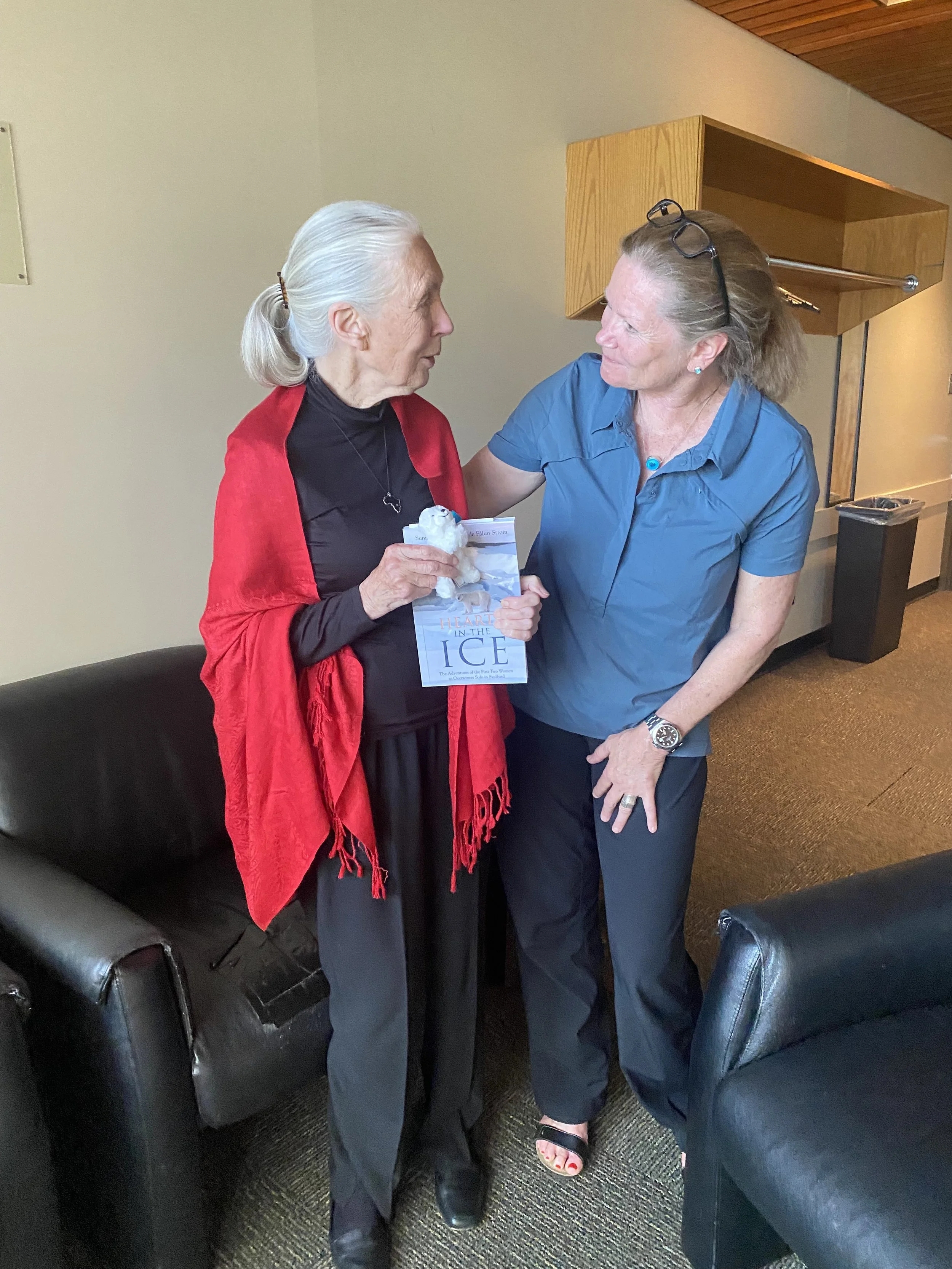
My deep inspiration comes from Dr.Jane Goodall who I will forever hold in my heart and as the North star for my work and service!
🚶♀️🧡🌌
